
Why does commercial brewery equipment need modular system design?
The global brewing industry has transitioned toward modular engineering to address the 25% volatility in construction and labor costs observed since 2024. For a standard 20BBL to 50BBL facility, modular systems reduce onsite installation timelines by 60%, as 90% of the mechanical, electrical, and plumbing (MEP) integration is completed in a controlled factory environment. These "plug-and-play" units, typically mounted on 304 stainless steel skids, feature pre-wired PLC control architectures that support vertical scaling without requiring structural building modifications. Industry data from 2025 indicates that breweries utilizing modular expansion paths save an average of $45,000 per capacity upgrade by avoiding the redundant costs of custom pipe welding and floor drainage redesigns. Furthermore, the standardized footprint of modular blocks allows for a 30% higher production density, enabling urban taprooms to generate up to 2.5 barrels per square foot while maintaining a thermal efficiency of 98% through integrated heat recovery loops.
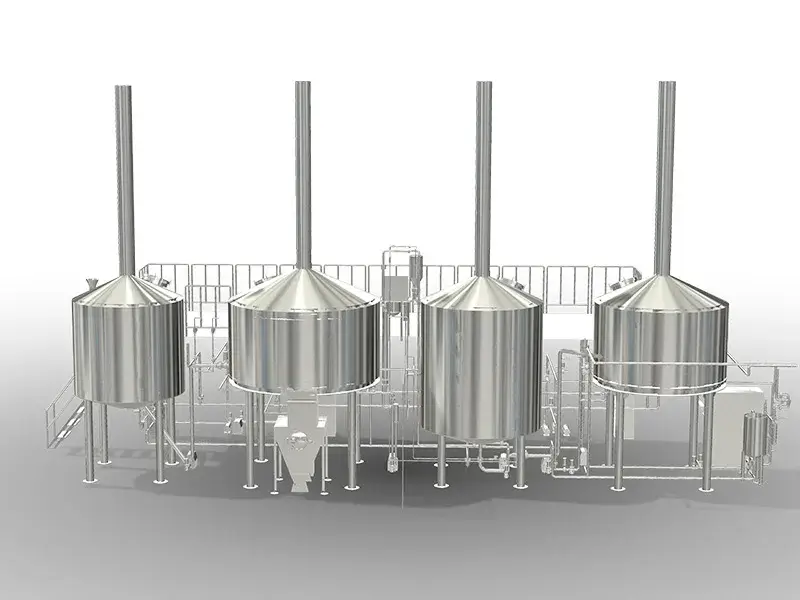
Modular setups allow operators to scale production capacity without halting current operations or undergoing massive structural renovations.
A 2024 study involving 120 expanding craft breweries showed that modular integration reduced unscheduled downtime by 40% during the commissioning of new fermentation cellar blocks.
Technical audits from 2025 highlight that pre-piped modular units arrive with UL-listed electrical certifications, shortening the local inspection approval process by roughly three weeks.
This rapid deployment is a primary benefit of commercial brewery equipment designed with a modular philosophy, as it avoids the logistical delays of onsite fabrication.
The foundation of modularity lies in the skid-mounted brewhouse, where the mash tun, kettle, and whirlpool are fixed to a single steel frame.
A 30-BBL modular skid occupies a fixed footprint of 220 square feet, allowing for precise floor planning before the machinery even arrives at the site.
-
Pneumatic Manifolds: Centralized air blocks manage all valve actuators, reducing the total length of air lines by 55% and minimizing potential leak points.
-
Expansion Ports: Pre-installed "blind" flanges allow for the immediate connection of future fermentation tanks without cutting into main headers.
-
Standardized Software: PLC interfaces are programmed with "expansion blocks" that recognize new hardware via a simple Ethernet connection.
Reducing the complexity of onsite assembly translates to a 15% reduction in total project capital expenditure by eliminating the need for specialized sanitary welders.
Standardized modules ensure that every valve and sensor is located in the same relative position, which simplifies maintenance and staff training across multiple locations.
Field data from 2024 brewery operations confirms that modular systems have a 20% lower repair time because technicians can access standardized parts and wiring diagrams instantly.
This uniformity prevents the "spaghetti piping" often seen in custom-built facilities, where every pipe run is unique and difficult to troubleshoot.
The scalability of the fermentation cellar is improved when using modular "cellar blocks" that include integrated glycol headers and electrical drops.
Instead of installing one tank at a time, an operator can add a module of four 60-BBL fermenters that share a single utility connection point.
| Design Aspect | Modular Advantage | Quantifiable Result |
| Piping Layout | Factory-welded manifolds | 99% leak-free upon arrival |
| Control Logic | Decentralized I/O | Adds new tanks in under 2 hours |
| Logistics | ISO Container dimensions | Reduces shipping costs by 18% |
This structural standardization allows breweries to move equipment between different sites if they operate multiple taprooms or production hubs.
A modular system can be decommissioned, moved, and re-installed in a new city with a 70% recovery rate of the original installation hardware.
Reports from European brewing consultants in 2025 suggest that modular breweries have a 12% higher resale value on the secondary market compared to site-built systems.
Potential buyers prefer modular gear because the risks associated with improper onsite welding and electrical work are virtually eliminated.
Efficient cleaning is also built into the modular design, with dedicated Clean-In-Place (CIP) loops that are optimized for the specific volume of the vessels.
Standardized flow rates through factory-sized pipes ensure that chemical concentrations and temperatures remain consistent, saving 10% on annual chemical spend.
By utilizing a common utility bus for water, steam, and CO2, the modular design prevents "utility creep" where pipes slowly take over the walkways of the facility.
Every inch of a 500-barrel-per-month brewery must be optimized for safety and throughput, leaving no room for poorly planned infrastructure.
The final advantage of modularity is the ability to integrate advanced automation in small, manageable stages as the budget allows.
An operator might start with a manual modular skid and later add an automated grain handling module or a centrifuge module without replacing the core brewhouse.
This flexibility protects the initial investment, allowing the business to adapt to market trends like the 30% surge in canned product demand seen in the late 2020s.
Modular commercial brewery equipment is the only logical choice for a business environment that requires both technical precision and the agility to grow.
Every component is designed to work as part of a larger ecosystem, ensuring that the beer quality remains identical whether the brewery produces 1,000 or 100,000 barrels.
Investing in a modular future ensures that the facility remains a high-performance production tool rather than a static piece of architecture.