
What are the key steps in the aluminium manufacturing process from bauxite to metal?
The production of primary aluminum begins with mining bauxite, a sedimentary ore typically containing 40% to 60% alumina. This raw material undergoes the Bayer process, where chemical digestion with sodium hydroxide extracts alumina ($Al_2O_3$). Refined alumina then enters the Hall-Héroult electrolysis stage, consuming 13 to 15 MWh of electricity per ton produced. By passing a current of up to 500,000 amperes through a molten bath at 950°C, manufacturers isolate pure metal. This aluminium manufacturing process yields material with 99.7% purity, ready for alloying and casting into aerospace or automotive components.
Mining starts with open-pit extraction of bauxite, a mineral-rich ore commonly found in tropical regions near the equator.
Industry data from 2025 indicates that global bauxite production exceeds 400 million tonnes annually to satisfy market demand.
Heavy machinery removes surface vegetation and topsoil to reach the ore, which sits within 10 meters of the ground.
Once extracted, the ore undergoes mechanical crushing to a uniform particle size, typically below 10 millimeters, for consistent processing.
The crushed material moves to washing plants to remove sand, clay, and other insoluble organic matter from the bauxite.
Washed bauxite enters large pressurized digesters where a concentrated solution of sodium hydroxide dissolves the alumina content.
The reaction occurs at temperatures between 140°C and 250°C under high-pressure conditions inside thick-walled steel vessels.
The resulting liquid, known as sodium aluminate, separates from the insoluble impurities called red mud through specialized filtration systems.
Approximately 95% of the alumina contained in the raw ore is successfully captured during this chemical digestion stage.
Red mud is sequestered into managed storage ponds to prevent leakage, adhering to international environmental safety protocols for disposal.
The filtered sodium aluminate solution travels to large precipitators where it cools, encouraging aluminum hydroxide crystals to form gradually.
These crystals seed the mixture, allowing solid aluminum hydroxide to settle out of the liquid stream over several hours.
Operators rotate the slurry until the crystals reach the required size for filtration and subsequent high-temperature heating stages.
The moist hydroxide enters rotary kilns or fluidized bed calciners operating at temperatures consistently above 1,000°C.
Thermal treatment drives off chemically bound water, converting the hydroxide into dry, white alumina powder ($Al_2O_3$) for smelting.
Dry alumina is transported to smelting facilities for conversion into molten aluminum metal via the Hall-Héroult electrolytic method.
Smelting utilizes carbon-lined steel cells that hold a bath of molten cryolite ($Na_3AlF_6$) at roughly 950°C to 960°C.
Cryolite acts as a liquid solvent, allowing the alumina to dissolve effectively so the electrolysis reaction can take place.
A powerful electrical current, often reaching 500,000 amperes, passes through the bath between carbon anodes and the cell lining.
"Electrolytic reduction represents the largest energy expenditure in aluminum production, requiring precise voltage regulation to maintain consistent metal yield."
The oxygen in the alumina reacts with the carbon anodes, producing carbon dioxide gas and leaving behind pure liquid metal.
The molten aluminum settles at the bottom of the cell because its density is higher than the electrolyte bath.
Operating the cells requires continuous power; plants often locate near hydroelectric sources to manage energy costs for production.
Data from 2024 shows that smelting efficiency has improved, with energy consumption per ton dropping by 3% over previous decades.
High-purity aluminum produced in the pots often contains 99.7% aluminum, meeting the requirements for most industrial grade alloys.
Remaining impurities such as iron or silicon are minimized during the final tapping and furnace treatment stages before casting.
Molten metal is siphoned from the pots into holding furnaces where alloying elements are added to enhance mechanical properties.
Common additions include magnesium, silicon, or copper, which adjust the metal's strength, ductility, or resistance to chemical corrosion.
The alloyed liquid flows into casting machines to form ingots, billets, or large slabs for downstream industrial manufacturing.
Direct chill casting is the standard method, creating uniform grain structures in the solidified metal pieces for consistency.
Finished products are measured for metallurgical compliance before shipping to automotive or aerospace component manufacturers for final assembly.
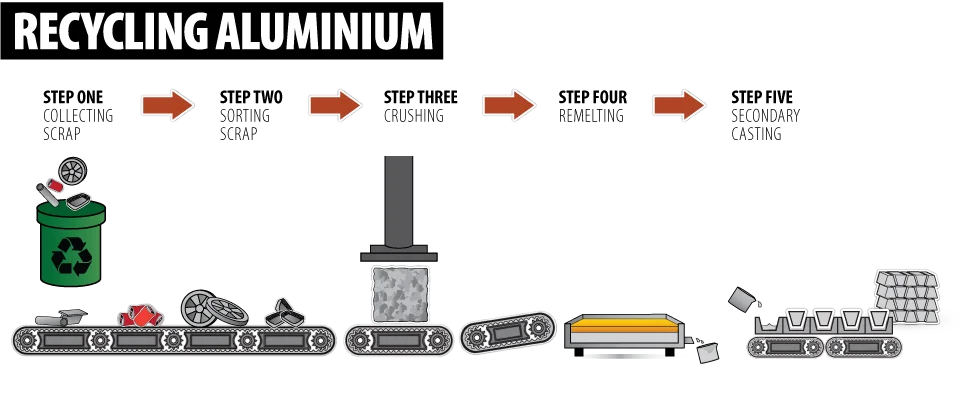
Aluminum recycling is an integral part of the industry, as it requires only 5% of the energy needed for smelting.
In 2026, industry reports suggest that over 70% of all aluminum ever produced remains in active use due to recyclability.
Recovered metal is remelted and purified, closing the loop on the material lifecycle and reducing demand for raw ore.
The secondary production path bypasses the Bayer and Hall-Héroult stages, offering substantial efficiency gains for the sector globally.
The ability to reuse metal without losing material quality ensures aluminum remains a dominant resource in modern engineering applications.